 Fargo Kitchen Exhaust Cleaning
 Kitchen Exhaust Fan Cleaning & Repair in Fargo
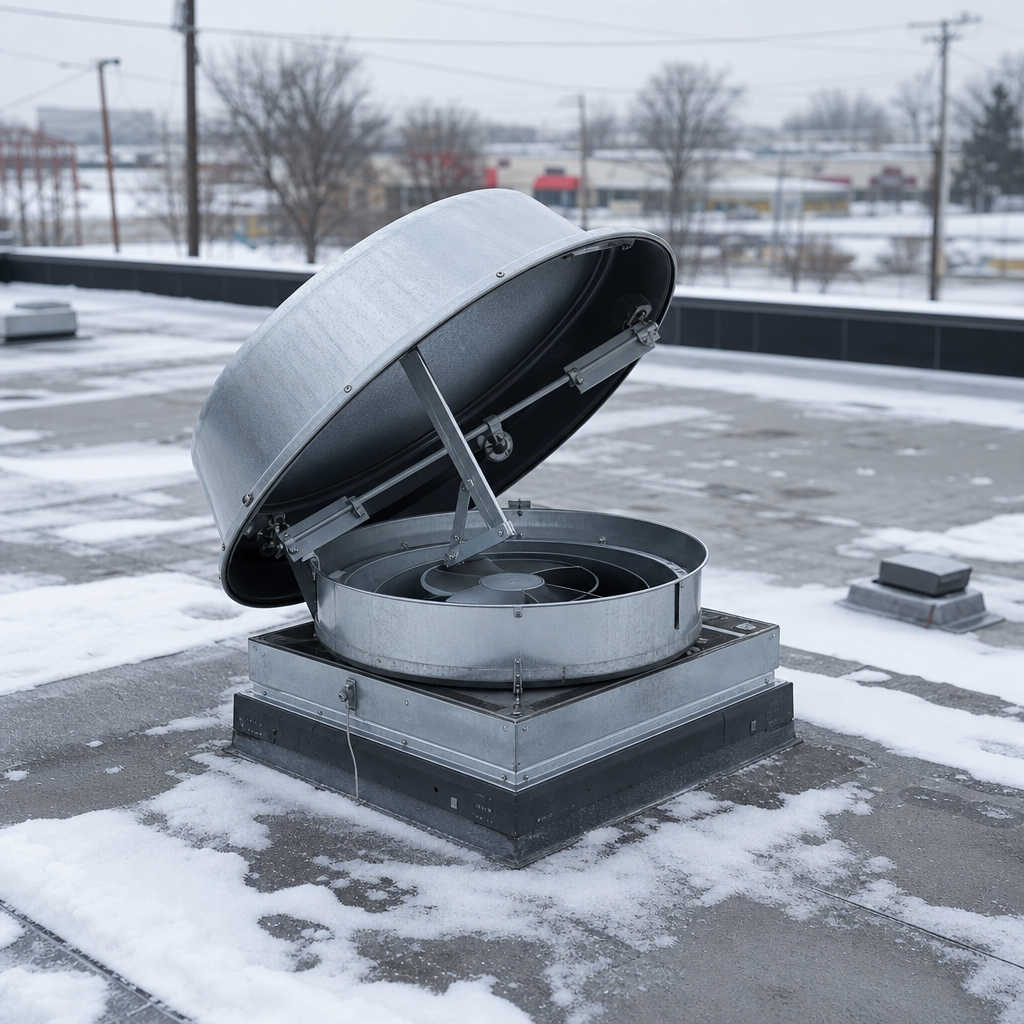
The rooftop fan is the hardest-working and worst-treated part of your kitchen exhaust system. It runs every hour your line does, loaded with grease, on a roof nobody visits, in a climate that swings a hundred-plus degrees across the year. Fan service covers degreasing the housing and blades, belt and bearing checks, hinge kit installs ($150–$300), and grease containment at the roof curb, scheduled with your full exhaust cleaning or as its own visit when something up there starts to squeal.
In Fargo, fan work comes with a season attached. More on that below, because it’s the part national vendors get wrong.
What the fan does, and what grease does to it
Every exhaust system ends at the fan. It’s what actually pulls air through the hood, and it’s the only mechanical component in the whole grease path. That combination makes it the system’s weak point:
- Grease in the housing. NFPA 96 treats fan housings as their own case for good reason. The cleaning trigger there is 0.125 inches of measured buildup. Grease pools in the housing and coats the blades.
- Imbalance. Grease never loads a fan wheel evenly. An unbalanced wheel vibrates, and vibration eats belts and bearings months ahead of schedule.
- Grease at the curb. What the fan slings out lands on the roof membrane around the unit. Left alone, it degrades the membrane and turns the fan’s perimeter into a slip hazard for every crew that ever works up there. Containment systems catch it; service visits empty them.
- Capture failure. A fan running slow on a slipping belt doesn’t move design airflow, which means your hood stops capturing smoke and vapor at the line. The kitchen gets hazy before anyone thinks to look at the roof.
A full exhaust cleaning includes degreasing the fan. Fan service goes further: belts, bearings, wheel condition, and the hardware that makes future cleanings possible.
Hinge kits: the $150–$300 fix that upgrades every future service
To clean a fan properly, and to reach the top of the duct run, the fan has to move. A hinge kit mounts the fan on a hinged base so it tips back safely instead of being unbolted, lifted, and set on the roof (a maneuver that damages ductwork, roofs, and occasionally the fan itself).
If your fan isn’t hinged, every cleaning of your upper duct is a compromise. The install runs $150–$300 in parts and labor, it’s done in a single visit, and it’s the single best money-per-outcome upgrade in this trade. Crews flag missing hinge kits in the service report; inspectors notice them too.
The winter reality: fan service on a Fargo roof
Here’s the genuinely local part. Most of this market’s kitchens sit under flat or low-slope roofs, and from roughly Thanksgiving to April those roofs carry snow, ice, and wind chills that make careless work dangerous. Kitchens keep cooking through all of it, which means fans keep loading with grease through all of it, and January is precisely when a marginal belt or bearing lets go.
What that means in practice:
- Winter service happens, and it’s routine, but it’s slower. Crews clear snow from the work area, verify the access route, and de-ice around the unit before wrenches come out. Slower means scheduled, not squeezed in.
- Cold is hard on marginal components. Stiff belts slip; tired bearings drag. A fan that hummed through October can fail in the first real cold snap, and a dead fan doesn’t just smoke out the kitchen, a line that can’t exhaust is a line that can’t legally run.
- Fall is the smart season. The right rhythm for this climate: heavy work (degreasing, belt and bearing replacement, hinge kit installs, curb containment) done in September and October on dry roofs, so winter visits are inspection and touch-up rather than emergency mechanics on ice.
- Access gets harder downtown. Broadway-corridor buildings with shared roofs and alley ladder access are a different winter proposition than a strip-mall kitchen with an interior roof hatch. It’s a real price and scheduling factor; say so at the walkthrough.
None of this is a reason to defer roof work in winter. It’s a reason to plan it, the kitchens that get hurt are the ones that treat the fan as invisible until it stops.
What a fan service visit covers
- Access and safety check: roof route, and in winter, snow and ice clearance around the unit.
- Degrease: housing, blades, and wheel, to the same bare-metal endpoint as the rest of the system.
- Mechanical check: belt condition and tension, bearing noise and play, wheel balance, mounting hardware.
- Curb and containment, grease containment emptied or installed, roof membrane around the unit checked and photographed.
- Documentation, findings and photos go into the same service report as your exhaust cleaning, alongside the sticker. If something needs parts, you get told with evidence, not upsold with adjectives.
Pricing and scheduling
| Item | Typical price |
|---|---|
| Fan degreasing with full system cleaning | included in the $300–$700 single-hood service |
| Rooftop fan hinge kit install | $150–$300 (parts + labor vary) |
| Rush / pre-inspection visit | +25–50% |
Belt, bearing, and containment work is quoted after a look, honest vendors don’t price unseen mechanical repairs. The pricing page has the full published table and every cost driver.
Fan work is performed by the same certified, insured local companies that handle the rest of the exhaust system, coordinated through one schedule so the roof never gets orphaned between vendors. If your fan is squealing, smoking, or simply hasn’t been looked at since you took over the kitchen, call (701) 765-5584 or send the form: we cover Fargo, West Fargo, Horace, Casselton, and the Grand Forks route, in every month North Dakota has.
Frequently Asked Questions
Why does the rooftop fan need its own attention?
The fan is the end of the grease path and its only moving part. Grease loads the housing and blades, throws the wheel out of balance, wears belts and bearings, and spills around the roof curb. NFPA 96 flags fan housings specifically. The cleaning trigger there is 0.125 inches of buildup, measured by depth gauge. A clean hood over a dead fan is still a kitchen that can't cook.
What is a hinge kit and do I need one?
A hinge kit lets the fan tip back on its base so crews can access the fan and the top of the duct without unbolting or crane-lifting the unit. If your fan isn't hinged, part of your system is hard to clean properly, and hard-to-clean becomes not-cleaned. Installation runs $150–$300 in parts and labor, and it pays for itself in service quality on every visit afterward.
Can you service a rooftop fan in the middle of winter?
Yes, kitchens don't stop cooking in January, so crews don't stop climbing. Winter service means clearing snow and ice from the work area, verifying safe roof access, and slower, more careful movement on a flat roof at below-zero wind chills. It's routine for crews here, but it's slower, which is why the smart schedule puts your heavy fan work in fall and keeps winter visits to inspection and maintenance.
My fan is squealing. Is that urgent?
Treat it as urgent. A squeal is usually a belt slipping or a bearing on its way out, and both fail fastest under winter load. If the fan quits, your hood can't capture smoke and grease vapor, and the line shuts down. A same-week look (belt, bearings, wheel balance) is cheap; discovering the problem during a Friday rush is not.
Do you replace fans or just clean them?
The crews we connect you with degrease fans, replace belts, service bearings, install hinge kits, and set up grease containment at the curb. If a fan is genuinely at end of life, you'll get that told to you straight, with photos of why, not a patch job on a unit that will strand your kitchen in February.