 Fargo Kitchen Exhaust Cleaning
 Restaurant Hood & Duct Cleaning in Fargo
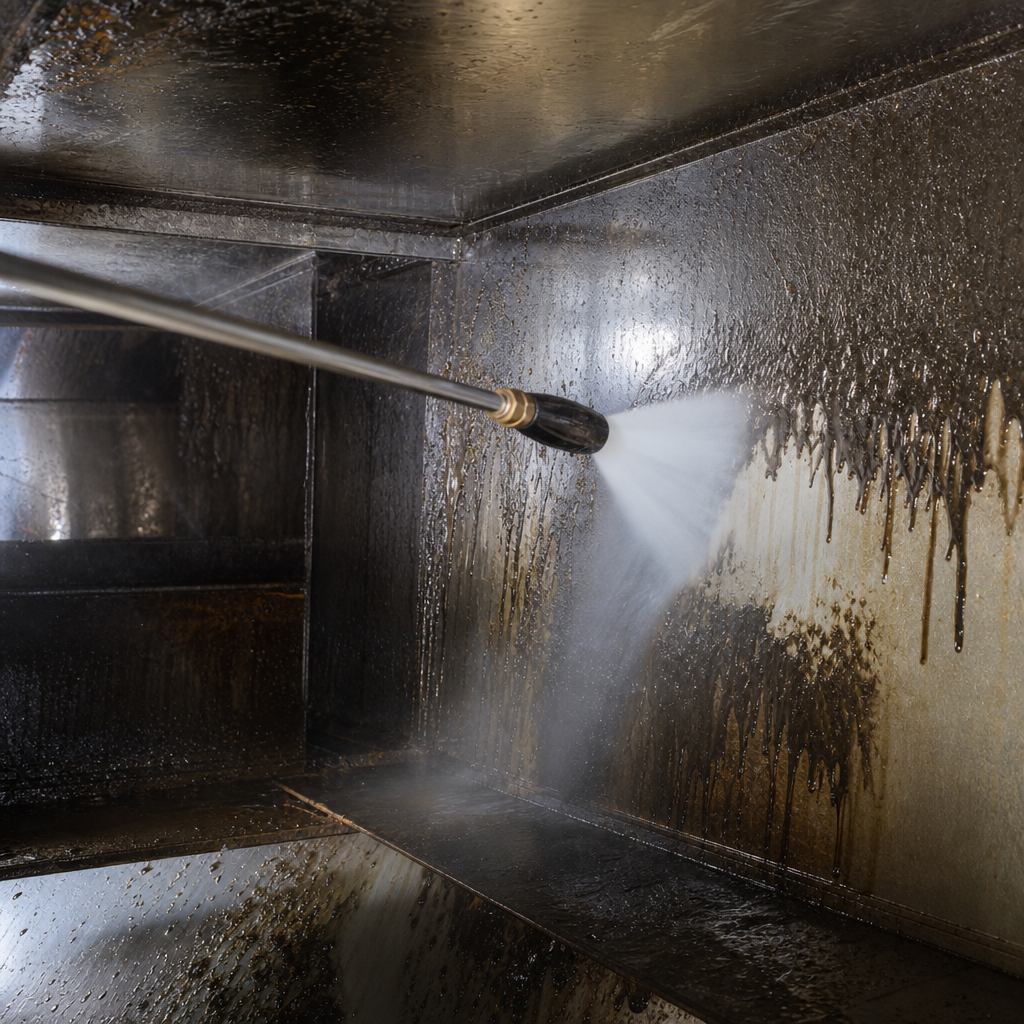
Restaurant hood cleaning (full kitchen exhaust cleaning, to give it its proper name) removes the flammable grease your cooking line deposits through the entire exhaust system: canopy, baffle filters, plenum, ductwork, and rooftop fan, cleaned to the NFPA 96 bare-metal standard. In the Fargo–Moorhead market a single-hood system typically runs $300–$700 per service, the work happens overnight, and every job ends with photos, a written report, and a dated certification sticker on the hood.
That last paragraph is the whole service. The rest of this page explains why each piece matters, because the difference between a real exhaust cleaning and a $200 canopy wipe is the difference between a compliant kitchen and a duct full of fuel.
The system is a grease path, not a hood
Every hour your line runs, grease-laden vapor rises off the appliances and travels one route: through the baffle filters, into the plenum behind them, up the duct, and out the rooftop fan. Grease condenses on every surface along the way, and it doesn’t distribute evenly:
- Filters catch the coarse load. They’re designed to, and they’re the easiest part to keep clean. (If yours are bent or burned through, the filter exchange service fixes that on a route schedule.)
- The plenum, the chamber directly behind the filters, collects the heaviest hidden buildup in most kitchens. You can’t see it from the floor. Fire inspectors can, and do, pull filters to look.
- The duct is where a flash fire travels and accelerates. It’s also the section cut-rate vendors skip, because it’s the hardest to reach.
- The fan accumulates grease in its housing and slings it around the roof curb. It’s part of the cleaning, and mechanically it’s its own service. See exhaust fan cleaning and repair.
A proper service treats all of it as one job, because a fire will.
The standard: bare metal, by the book
Two numbers define a legitimate hood cleaning, and both come from NFPA 96, the standard pulled into force by the fire code enforced by the Fargo Fire Department:
- The trigger. Under §12.6.1, grease is measured with a depth-gauge comb during inspection; the system requires cleaning at 0.078 inches (2000 microns) of buildup on surfaces, or 0.125 inches in fan housings.
- The endpoint. Cleaning proceeds to “bare metal”, no more than 0.002 inches (50 microns) of residual combustible contaminant. The method standard the code cites is ANSI/IKECA C10.
Between those two numbers is the actual work: hot pressure-washing, caustic degreasers where the load demands it, and hand-scraping in the plenum and duct where pressure alone won’t reach the steel. “Looks clean” is not the standard. Bare metal is, and the before-and-after photos in your service report prove it was met.
How often the cycle repeats depends on your cooking volume: NFPA 96 Table 12.4 sets inspection at monthly for solid fuel, quarterly for high-volume lines, semiannual for moderate, annual for low-volume operations. The NFPA 96 compliance page walks through placing your kitchen in that table and keeping the paperwork straight.
What an overnight service looks like
1. Walkthrough and quote. Before anything is scheduled, someone looks at your actual system: hood count, duct route, roof access, grease condition. That’s where the $300–$700 range becomes one firm number. Free, and it takes half an hour.
2. Protection. After close, the crew wraps the cook line, covers the appliances, and hangs containment so wash-down water goes into recovery, not across your floor and into the floor drain. (Grease belongs in the trap, not sheeting past it.)
3. Filters out, system open. Baffle filters come down and get degreased, or swapped. The plenum and duct get opened up for access.
4. The wash. Hood, plenum, duct, and fan get degreased and hot-pressure-washed to bare metal, with hand-scraping where buildup is heavy. On a first visit to a neglected system, this step is most of the night.
5. Reassembly and documentation. Filters back in, panels closed, line unwrapped, floor dry. The crew photographs the after-state to match the before-state, writes the service report, and applies the dated certification sticker to the hood.
That sticker and report are not souvenirs. They’re what a Fargo Fire Department inspector asks to see, and what an insurance carrier or adjuster asks for after any fire. Walking out without them means the job isn’t done.
Fargo specifics worth knowing
Downtown is harder, and priced like it. The Broadway corridor’s century-old brick buildings carry long vertical duct runs, shared roofs, and alley-only access. That’s more surface area and more setup than a strip-mall kitchen on 13th Avenue, one reason the honest answer to “what does it cost” is a range until someone sees the building.
Winter is real. Roof work continues through a North Dakota winter, but snow and ice on a flat roof slow everything down. Kitchens that book their fall service on time, before the freeze, get the easy version; the fan service page covers the winter mechanics in detail.
Who does the work. North Dakota has no state license for hood cleaners, so the bar that matters is the NFPA 96 one: properly trained, qualified, and certified persons acceptable to the authority having jurisdiction. The crews we connect you with are certified (IKECA’s CECS and CECT are the industry credentials) and insured, and we’re straightforward about our own role: Fargo Kitchen Exhaust Cleaning coordinates the work; certified local companies perform it.
What it costs
| Configuration | Typical price |
|---|---|
| Small single hood, light line | $200–$450 |
| Standard single-hood system | $300–$700 |
| Large or complex single system | to $800+ |
| Multi-hood (2–4 hoods) | $800–$1,500 |
| Rush / pre-inspection service | +25–50% |
Price depends on hood count, duct run length, roof access, and grease load, the pricing page publishes the full table and every driver, and the walkthrough quote is free.
If your sticker is current and your cadence is set, you don’t need us yet. If either of those isn’t true, call (701) 765-5584 or send the form. One overnight visit puts your system at bare metal with the paperwork to prove it, in Fargo, West Fargo, or anywhere on our metro routes.
Frequently Asked Questions
What exactly gets cleaned in a full hood cleaning?
The entire grease path: hood canopy inside and out, baffle filters, the plenum behind them, the full duct run to the roof, and the rooftop fan. The endpoint is the NFPA 96 bare-metal standard, no more than 0.002 inches of residual combustible contaminant, using the ANSI/IKECA C10 method. A service that stops at the canopy isn't a hood cleaning; it's a wipe-down.
How long does a hood cleaning take?
Most single-hood systems are done inside one overnight window between close and morning prep. Multi-hood kitchens, long downtown duct runs, or a first cleaning on a neglected system can run longer, sometimes split across two nights so your kitchen never misses a service. The walkthrough sets the schedule honestly before anyone books.
Will the crew mess up my kitchen?
The line gets wrapped and protected before any water moves, wash-down water is captured and removed rather than sent across your floor, and the kitchen is returned service-ready. The honest caveat: this is pressure-washing flammable grease off steel at height. It's industrial work. The measure of a good crew is that at 8 a.m. you can't tell they were there, except the system is bare metal and the sticker is new.
How often do I need this?
It depends on what you cook. NFPA 96 Table 12.4 requires inspection monthly for solid-fuel cooking, quarterly for high-volume lines (24-hour, charbroiling, wok), semiannually for moderate volume, and annually for low-volume kitchens, with cleaning triggered by the grease depth the inspection finds. Most Fargo restaurants land on a semiannual or quarterly cadence.
Do you clean systems in Moorhead too?
Yes, crews cover the full Fargo–Moorhead metro. The standard is the same on both sides of the river: NFPA 96, bare metal, ANSI/IKECA C10, photos and a report at the end.